 EN
EN  BG
BG HR
HR CS
CS DA
DA NL
NL FI
FI FR
FR DE
DE IT
IT JA
JA KO
KO NO
NO PL
PL PT
PT RU
RU ES
ES SV
SV TL
TL SR
SR SK
SK UK
UK VI
VI TH
TH MS
MS BE
BE HY
HY
Introduction
Choosing a hydraulic adapter OEM affects far more than unit price. These components sit at critical pressure points in fluid systems, so small differences in thread accuracy, metallurgy, surface treatment, and process control can determine whether equipment runs reliably or fails in service. This article explains the standards that matter, how to evaluate manufacturing quality beyond basic claims, and where cost is truly driven across tooling, volumes, testing, and supply consistency. By the end, readers will have a clearer framework for comparing suppliers, balancing technical compliance with commercial realities, and reducing risk in both custom and catalog adapter sourcing.
Why OEM Selection Matters for Hydraulic Adapters?
Procuring hydraulic adapters requires meticulous evaluation of manufacturing partners, as these components serve as critical junctions in high-pressure fluid power systems. The integrity of an entire hydraulic circuit often hinges on the dimensional accuracy and material strength of these connectors. Identifying a highly capable Original Equipment Manufacturer (OEM) ensures technical specifications are consistently met, mitigating operational hazards and supply chain disruptions.
OEM Definition in Industrial Supply
In industrial fluid power, an OEM is a manufacturing entity that produces hydraulic adapters as standardized catalog items or custom-engineered components for specific machinery. These manufacturers utilize multi-axis CNC machining centers to produce millions of units annually, supplying heavy equipment builders, the automotive sector, and tier-one distributors. High-volume production typically requires minimum order quantities (MOQs) ranging from 5,000 to 10,000 units per run for custom profiles, allowing the manufacturer to amortize setup costs while maintaining tight unit economics.
Commercial Risks of Poor OEM Selection
Partnering with an unverified or underperforming OEM introduces severe commercial and operational liabilities. A single catastrophic failure of a hydraulic adapter can lead to rapid fluid loss, resulting in unexpected equipment downtime that often exceeds $5,000 per hour in heavy industrial operations. Furthermore, inconsistent thread machining or compromised plating can cause micro-leaks, environmental contamination fines, and accelerated component wear. Top-tier OEMs typically maintain a defect rate strictly below 50 parts per million (PPM). In contrast, substandard suppliers lacking robust statistical process control may exhibit defect rates exceeding 500 PPM, directly impacting the final assembler's warranty claims and brand reputation.
Standards, Materials, and Quality Control for Hydraulic Adapters

To guarantee component interchangeability and safe operation under dynamic loads, hydraulic adapters must strictly adhere to globally recognized engineering standards. The intersection of precise thread geometries, appropriate material selection, and rigorous quality assurance protocols separates premium OEM products from high-risk alternatives.
Thread Standards, Pressure Ratings, and Material Grades
Hydraulic systems operate under extreme conditions, necessitating strict adherence to specifications such as SAE J514 for JIC 37-degree flare fittings , SAE J1453 for O-Ring Face Seal (ORFS) connectors , and ISO 8434-1 for metric bite-type fittings. ORFS adapters, for example, are engineered to handle dynamic pressures up to 6,000 PSI (414 bar) while providing exceptional resistance to high-frequency vibration. Material selection is equally critical. Most industrial adapters are machined from carbon steel grades such as 12L14 or 1045, which must be protected against corrosion. Premium OEMs apply advanced surface treatments, such as zinc-nickel plating, routinely specified to withstand upwards of 720 hours to red rust during ASTM B117 salt spray testing. For marine or highly corrosive chemical environments, austenitic stainless steel (316L) is the mandated standard.
Inspection, Traceability, Testing, and Certification
Validating an OEM's manufacturing capability requires examining its quality control infrastructure. Leading facilities employ Coordinate Measuring Machines (CMM) and optical comparators to verify thread pitch, root radii, and concentricity down to micron-level precision. Full material traceability is a non-negotiable requirement; facilities must provide EN 10204 3.1 material certificates to prove the chemical composition and mechanical properties of the raw bar stock.
| Standard | Connection Type | Typical Max Pressure (Steel) | Primary Application |
| SAE J514 | JIC 37° Flare | 3,000 - 5,000 PSI | General hydraulics, aerospace |
| SAE J1453 | ORFS (O-Ring Face Seal) | 4,000 - 6,000 PSI | High-vibration environments |
| ISO 1179 | BSPP (Elastomeric Seal) | Up to 5,800 PSI | European industrial machinery |
Additionally, comprehensive OEM partners maintain ISO 9001:2015 certification and conduct routine hydrostatic burst testing and impulse fatigue testing to ensure lot-to-lot reliability. This rigorous inspection guarantees that every adapter shipped can perform at its maximum rated pressure without yielding or leaking.
Comparing OEM Costs and Qualifying Suppliers
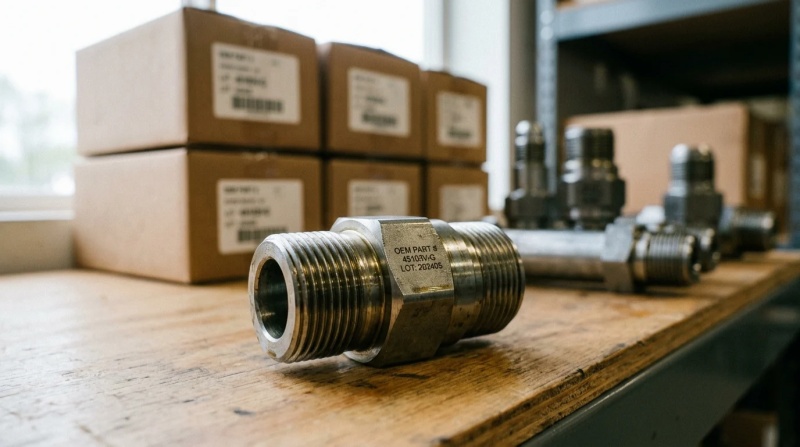
Strategic sourcing of hydraulic adapters requires balancing unit procurement costs against the total cost of ownership. Procurement engineers must evaluate an OEM's cost structure, logistical capabilities, and quality management systems through a formalized qualification framework to ensure long-term supply chain stability.
Cost Drivers, Logistics, and Supplier Comparison
The unit cost of a hydraulic adapter is heavily influenced by raw material markets, machining complexity, and regional labor rates. Raw steel or stainless bar stock typically accounts for 40% to 50% of the final unit cost. The remaining expenses encompass CNC machining time, surface plating, and quality inspections. Logistics and lead times also play a pivotal role in supplier selection. Offshore OEMs often provide significant piece-price advantages but generally require lead times of 8 to 12 weeks, inclusive of ocean freight. Conversely, domestic or nearshore OEMs can compress lead times to 4 to 6 weeks, though they may carry a 30% to 50% price premium. Supply chain managers must calculate inventory carrying costs against these lead times to determine the most cost-effective sourcing strategy.
Step-by-Step Supplier Qualification Process
Establishing a reliable OEM partnership demands a methodical qualification process. The initial phase involves a comprehensive desktop audit to assess the supplier's financial stability, ISO certifications, and historical performance metrics. Next, procurement teams request a Production Part Approval Process (PPAP) package, which includes dimensional layouts, material certifications, and initial sample runs. During this phase, critical dimensions must consistently demonstrate machining tolerances within ±0.001 inches. Following sample approval, an on-site facility audit is conducted to evaluate raw material quarantine procedures, tool-life management, and scrap handling protocols. Finally, buyers execute a pilot production run—typically 1,000 to 2,000 units—to verify that the OEM can maintain process capability and delivery timelines at scale before committing to multi-year, high-volume contracts.
Key Takeaways
· The most important conclusions and rationale for Hydraulic Adapter's OEM
· Specs, compliance, and risk checks worth validating before you commit
· Practical next steps and caveats readers can apply immediately
Frequently Asked Questions
What standards should a hydraulic adapter OEM meet?
Look for compliance with SAE J514, SAE J1453, or ISO 1179, depending on the connection type. The OEM should also hold ISO 9001:2015 certification.
Which material is best for hydraulic adapters?
Carbon steel suits most industrial systems, while 316L stainless steel is better for marine or corrosive environments. Match material to pressure, fluid, and exposure conditions.
How can I verify an OEM’s quality control?
Ask for EN 10204 3.1 material certificates, CMM inspection records, and burst or impulse test reports. A reliable OEM should also provide lot traceability.
Why does OEM selection affect total cost?
Low-priced adapters can raise costs through leaks, downtime, warranty claims, and replacements. A qualified OEM reduces defect risk and improves long-term supply reliability.
What MOQ is typical for custom hydraulic adapters?
Custom OEM runs often start around 5,000 to 10,000 pieces. Confirm MOQ, tooling charges, and lead time early to avoid sourcing delays.
Founded in 2004, NingBo NJ Hydraulic Adapter Co., Ltd specializes in manufacturing hydraulic fittings, hydraulic adapters, hose fittings, split flange kits, flange adapters, flanges, reusable hose fittings, ferrules, caps and plugs and so on, then sell to worldwide, especially North America, South America, Australia, Germany, UK. Our history of collaboration with our customers for specially designed hydraulic applications, has established NJ as an industry-preferred source for customer-specific manufactured adapters. We are proud to serve major markets including: construction, agriculture, mining, industrial equipment and more. All NJ fittings are manufactured to the highest standards, meeting S.A.E./BRITISH/EATON/DIN and INTERNATIONAL specifications. We control our own manufacturing both domestically and overseas. NJ has a strong inventory reserve, more than 20,000 warehouse has more than 25,000 series and sizes of fittings, far more than the competitors twice as much. From the time we receive your order until it arrives at your facility, we're committed to meeting your deadlines and delivery requirements. Our goal is to provide your fittings as fast as possible — when and where you need them — which also helps you keep your inventories and freight costs low. Whether you have an emergency or an ongoing need, send us an email. We deliver the fittings you want, along with the high quality, best after-sales service and competitive price you deserve.