
 EN
EN  BG
BG HR
HR CS
CS DA
DA NL
NL FI
FI FR
FR DE
DE IT
IT JA
JA KO
KO NO
NO PL
PL PT
PT RU
RU ES
ES SV
SV TL
TL SR
SR SK
SK UK
UK VI
VI TH
TH MS
MS BE
BE HY
HY
Introduction
Getting the size of a BSP pipe fitting right starts with understanding that the marked size does not match the outside thread diameter. To identify a fitting correctly, you need to measure the thread’s outside diameter, determine the thread pitch, and confirm whether it is parallel or tapered, since each affects compatibility and sealing. This guide explains the key dimensions, the tools commonly used, and the simple checks that help distinguish similar sizes without guesswork. By the end, you will be able to match BSP fittings more accurately, reduce installation errors, and choose parts that seal properly in hydraulic, pneumatic, or general pipe systems.
Why measuring BSP pipe fittings matters?
Accurate measurement of British Standard Pipe (BSP) fittings is fundamental for maintaining the integrity of industrial fluid power, petrochemical processing, and pneumatic systems. Incorrectly sized components severely compromise seal efficacy, leading to hydraulic fluid leaks, pressure losses, and catastrophic blowouts under high-stress operations. Engineers and facility technicians must navigate the unique sizing conventions of the BSP standard to guarantee structural interoperability across diverse international equipment platforms. Proper identification prevents the integration of mismatched metallurgical grades, ensuring that torque applications do not induce stress fractures in high-pressure environments.
Thread form, nominal size, and sealing method
The British Standard Pipe thread utilizes a Whitworth thread profile characterized by a precise 55-degree flank angle with rounded crests and roots. This standard is divided into two primary sealing methodologies defined by international norms: BSPP (British Standard Pipe Parallel, governed by ISO 228-1) and BSPT (British Standard Pipe Tapered, governed by ISO 7-1). BSPP relies on an elastomeric seal, such as a bonded sealing washer or O-ring, compressed between the fitting shoulder and the machined port face. Conversely, BSPT achieves a hermetic seal through thread interference, featuring a taper rate of 1:16—an approximate 3.58-degree incline along the thread axis. This tapered design often requires a thread sealant like PTFE tape or anaerobic curing compounds to eliminate microscopic spiral leak paths. A critical nuance of the BSP standard is the nominal sizing convention; a 1-inch nominal BSP fitting does not measure 1 inch in physical outer diameter, but rather aligns with the historical inner bore diameter of the carbon steel piping it was originally intended to join.
Key BSP terms to know before measuring
Navigating BSP specifications requires fluency in distinct measurement terminology. The Outside Diameter (OD) represents the major diameter of male threads, measured at the widest crest point, while the Inside Diameter (ID) denotes the minor diameter of female threads. Pitch is quantified as Threads Per Inch (TPI), a metric that dictates thread engagement compatibility across mating components. For instance, a 1/4-inch BSP fitting universally features 19 TPI, whereas a 1-inch fitting features 11 TPI. Understanding the working pressure threshold associated with these dimensions is equally critical. Standard 316 stainless steel BSPP fittings are frequently rated for dynamic operating pressures ranging from 3,000 to 6,000 PSI, contingent on the nominal size, wall thickness, and the specific elastomeric compound utilized in the sealing matrix.
How to measure BSP pipe fittings?
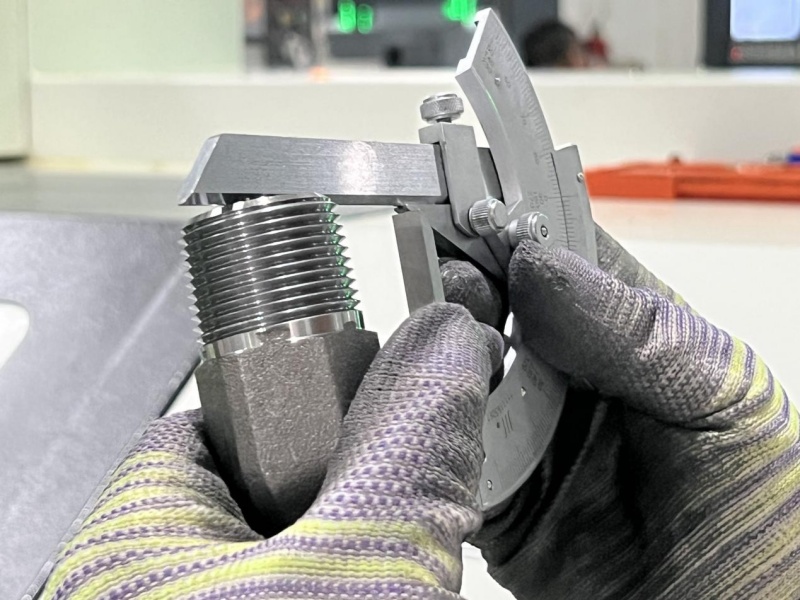
Executing a precise measurement protocol for BSP fittings dictates the use of calibrated instruments rather than relying on visual estimation or rudimentary rulers. The process requires systematically capturing the major diameter, minor diameter, and thread pitch to cross-reference these empirical data points against standardized engineering conversion tables.
Tools and step-by-step process
The foundational tools for this procedure include a digital or dial vernier caliper—capable of resolving to at least 0.01 millimeters (0.0005 inches)—and a dedicated Whitworth thread pitch gauge. The procedure commences by determining the geometric thread type. For a male fitting, position the caliper jaws perfectly perpendicular across the widest point of the threads to capture the Outside Diameter (OD). If evaluating a female port, utilize the internal caliper jaws to measure the Inside Diameter (ID) across the thread crests. Next, deploy the thread pitch gauge to determine the Threads Per Inch (TPI). Press the serrated gauge leaves into the threads until a perfect, light-tight geometric match is achieved. Finally, assess the fitting for taper to distinguish between parallel and tapered variants. Measure the OD at the first full thread near the tip, and perform a secondary measurement at the last full thread near the hex base. A differential of approximately 0.0625 inches per inch of thread length mathematically confirms a BSPT fitting, whereas identical parallel measurements confirm a BSPP fitting.
How to match measurements to BSP size?
Once the physical dimensions and TPI are recorded, technicians must map these empirical values to the corresponding nominal BSP size. Because BSP sizing is based on historical internal pipe bores rather than the actual thread diameter, relying strictly on direct caliper readings without a conversion matrix will result in sizing errors. For example, a fitting measuring 13.15 mm (0.518 inches) in OD with 19 TPI corresponds to a 1/4-inch nominal size, not a 1/2-inch size. The following reference table outlines the standard dimensional parameters for the most common BSP fitting sizes encountered in industrial fluid systems.
| Nominal BSP Size | Threads Per Inch (TPI) | Male Thread OD (mm) | Female Thread ID (mm) |
| 1/8" | 28 | 9.73 | 8.57 |
| 1/4" | 19 | 13.16 | 11.45 |
| 3/8" | 19 | 16.66 | 14.95 |
| 1/2" | 14 | 20.96 | 18.63 |
| 3/4" | 14 | 26.44 | 24.12 |
| 1" | 11 | 33.25 | 30.29 |
How to verify BSP fitting measurements?
After executing the primary measurement and cross-referencing phase, rigorous verification is mandatory prior to system assembly. The highly globalized nature of industrial supply chains means that hydraulic and pneumatic circuits frequently integrate components from diverse geographic origins, elevating the probability of thread standard misidentification and subsequent mechanical failure.
BSP vs NPT and metric threads
The most prevalent error in fluid power maintenance is conflating BSP threads with National Pipe Taper (NPT) or Metric thread profiles.
Key Takeaways
· The most important conclusions and rationale for how to measure bsp pipe fittings
· Specs, compliance, and risk checks worth validating before you commit
· Practical next steps and caveats readers can apply immediately
Frequently Asked Questions
What tools are best for measuring BSP pipe fittings?
Use a digital or dial caliper and a Whitworth thread pitch gauge. A ruler is usually too inaccurate for identifying BSP size and thread type.
How do I measure a male BSP fitting?
Measure the outside diameter across the thread crests at the widest point, then check the thread pitch with a Whitworth gauge. Compare both values to a BSP chart.
How do I measure a female BSP fitting?
Measure the inside diameter across the internal thread crests using caliper inside jaws. Then confirm the thread pitch with a Whitworth gauge and match both to a BSP table.
How can I tell if a fitting is BSPP or BSPT?
Measure the thread diameter near the tip and again near the base. If the size changes, it is BSPT tapered; if it stays the same, it is BSPP parallel.
Why doesn’t a 1-inch BSP fitting measure exactly 1 inch?
BSP uses nominal pipe size, not the actual thread diameter. Always identify the fitting by measured diameter plus TPI, then verify it against a BSP reference chart.
Founded in 2004, NingBo NJ Hydraulic Adapter Co., Ltd specializes in manufacturing hydraulic fittings, hydraulic adapters, hose fittings, split flange kits, flange adapters, flanges, reusable hose fittings, ferrules, caps and plugs and so on, then sell to worldwide, especially North America, South America, Australia, Germany, UK. Our history of collaboration with our customers for specially designed hydraulic applications, has established NJ as an industry-preferred source for customer-specific manufactured adapters. We are proud to serve major markets including: construction, agriculture, mining, industrial equipment and more. All NJ fittings are manufactured to the highest standards, meeting S.A.E./BRITISH/EATON/DIN and INTERNATIONAL specifications. We control our own manufacturing both domestically and overseas. NJ has a strong inventory reserve, more than 20,000 warehouse has more than 25,000 series and sizes of fittings, far more than the competitors twice as much. From the time we receive your order until it arrives at your facility, we're committed to meeting your deadlines and delivery requirements. Our goal is to provide your fittings as fast as possible — when and where you need them — which also helps you keep your inventories and freight costs low. Whether you have an emergency or an ongoing need, send us an email. We deliver the fittings you want, along with the high quality, best after-sales service and competitive price you deserve.